


Welcome to Nest Wellness! Browse hundreds of recipes in my recipe index, explore my ebooks over on my website, enjoy my new perks, or dive deeper with my Blood Sugar Method course.
I remember standing in my kitchen years ago, staring at a beautiful plate of salmon, roasted broccoli, a big green salad, and thinking, this has to be at least 10 grams of fiber. I put it into Cronometer to be sure and it was just 6 grams of fiber. Barely halfway to where I needed it to be. That was when I stopped guessing and started actually paying attention.


Last week, a woman in our community said something I hear all the time: “Beth, I eat SO many vegetables. How am I only getting 14 grams of fiber a day?”
She wasn’t doing anything wrong. She was eating well. This isn’t a willpower gap; it’s an information gap. Nobody hands you a fiber counter at the grocery store, and “eat your vegetables” was never going to get anyone to 30 grams a day on its own. The average person in the US gets about 15 grams of fiber daily, less than half of what we need. Protein, we’ve finally learned to watch. Fiber still flies under the radar until your digestion or your glucose curve starts telling on you.
So today I want to make this easy, not stressful. No powders, no pills, no choking down a glass of gritty psyllium husk. Just real meals that get you past 30 grams of fiber a day without turning it into a project.
first, a refresher on the numbers I live by
If you’ve been here a while, you know my midlife mantra by heart:
→ 25+ grams of protein per meal
→ 10 grams of fiber per meal (30+ grams daily)
→ 30 different plants per week
→ healthy fats with every meal
→ at least 1 ferment a day
→ 1,000–1,200 mg calcium daily
Today is a deep dive on fiber, the one most people underestimate the most.
If you want the science behind why fiber is such a metabolic powerhouse, I covered that in Fiber: The Unsung Hero of Metabolic Health. This post is the how-to companion: the actual meals.
Here’s the part I find fascinating, and I’ve watched it play out on my own CGM for years now: the exact same carbohydrate eaten with fiber versus without fiber gives you two completely different glucose responses. Fiber slows everything down. It flattens the curve, it feeds your gut bacteria, it keeps you full. When you build meals this way, blood sugar stability isn’t something you’re chasing anymore. You just have it.

where fiber math goes wrong
Before the meals, a few places I see people lose the plot without realizing it:
Counting a salad as “high fiber” because it’s a big pile of greens. Lettuce is mostly water — 2 cups of romaine gets you about 2 grams. The fiber comes from what’s on the salad: beans, seeds, lentils.
Getting fiber without protein in the same bite. Oatmeal with berries can hit 8 grams of fiber and still leave you hungry by 10am, because fiber slows digestion but protein and healthy fat are what keep you full and satiated (and protein and healthy fat are largely missing from oatmeal).
Adding fiber too fast. This one isn’t a mindset problem, it’s a gut problem, more on that below.


the 5 meals (each one links to a recipe you can make this week)
Each of these hits roughly 10 grams of fiber and lands near my 30-gram protein target, so you’re never trading one for the other. Fiber and protein travel together, that’s the rule. I am sharing a non-dairy and a plant-forward option, the way I always do.
Breakfast - Healthy High-Fiber Pancakes
I tested this recipe batch after batch, with Nolan and Camille as my taste-testers, until the texture was just right. Top them with berries and enjoy with a side of turkey sausage to round out the protein.Lunch or Dinner - Mediterranean Tuna + Bean Salad
White beans and chickpeas are two of the highest-fiber foods I put on a plate — together they bring about 12 grams of fiber to the bowl, alongside roughly 30 grams of protein. Most tuna salads are just protein and some crunch; this one adds real fiber.Lunch - Chicken Chickpea Salad with Harissa Dressing
Chickpeas are a fiber workhorse — a cup gets you close to 12 grams on their own, which is more than most people get in an entire day of “eating healthy.” The harissa makes this anything but boring. Plant-forward swap: chicken → tempeh, lupini beans, or lupin pasta.Dinner - Chili Pie
This is a recipe my family asks for all the time. Grain-free, built on black beans and lupin flakes, and it delivers 35 grams of protein and 12 grams of fiber per serving. Black beans and lupin flakes are doing something a meat-only chili can’t: they carry fiber and protein in the same bite, which is exactly why this dish keeps blood sugar steady instead of spiking and crashing.Anytime - Savory Protein Scones
21 grams of protein and 8 grams of fiber per scone, with 11 flavor variations. Most scones are a refined flour and sugar bomb; this one is built the opposite way, prioritizing protein and fiber. Breakfast with tea, as a snack, or alongside a bowl of soup.
your everyday booster
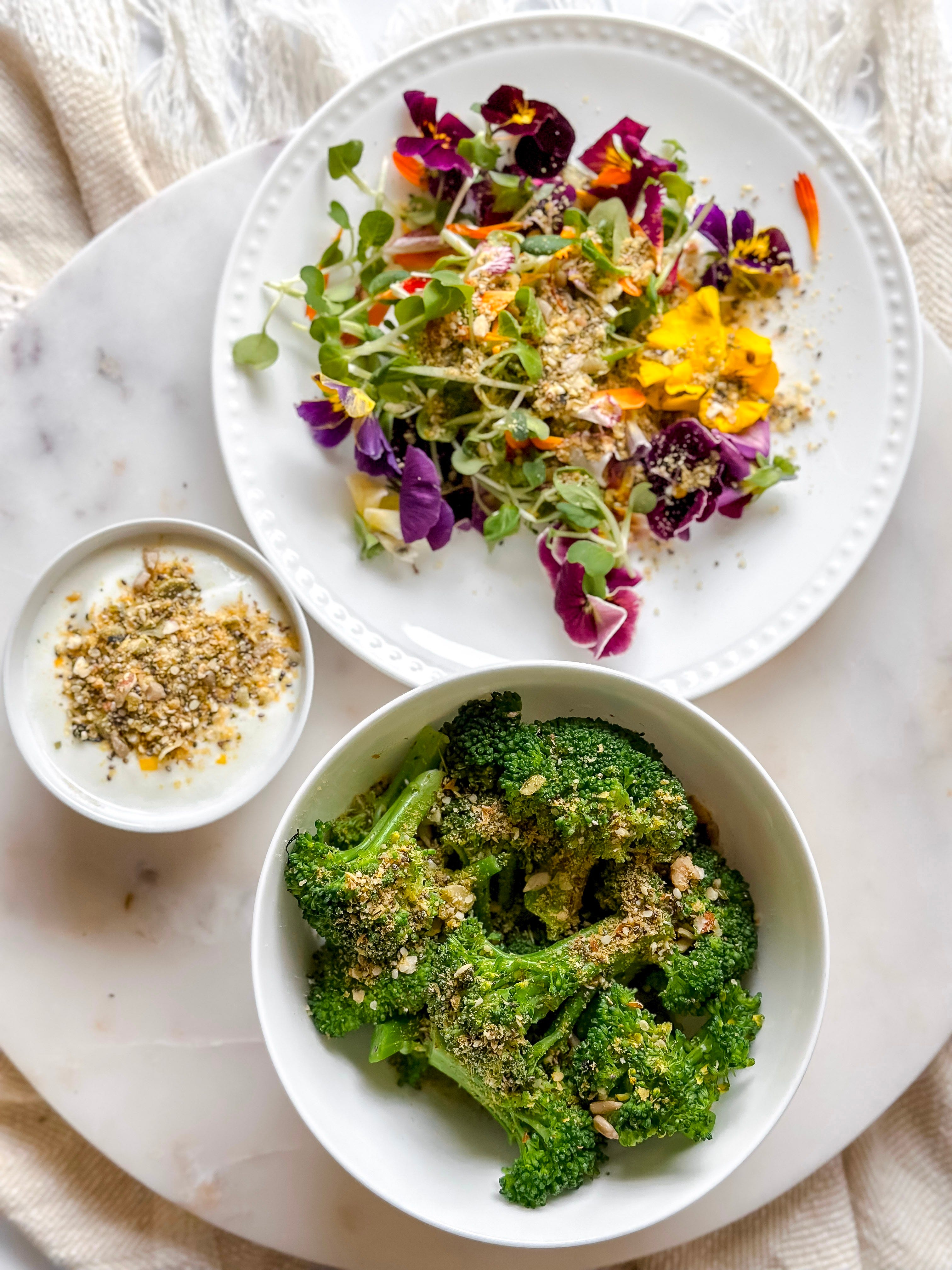
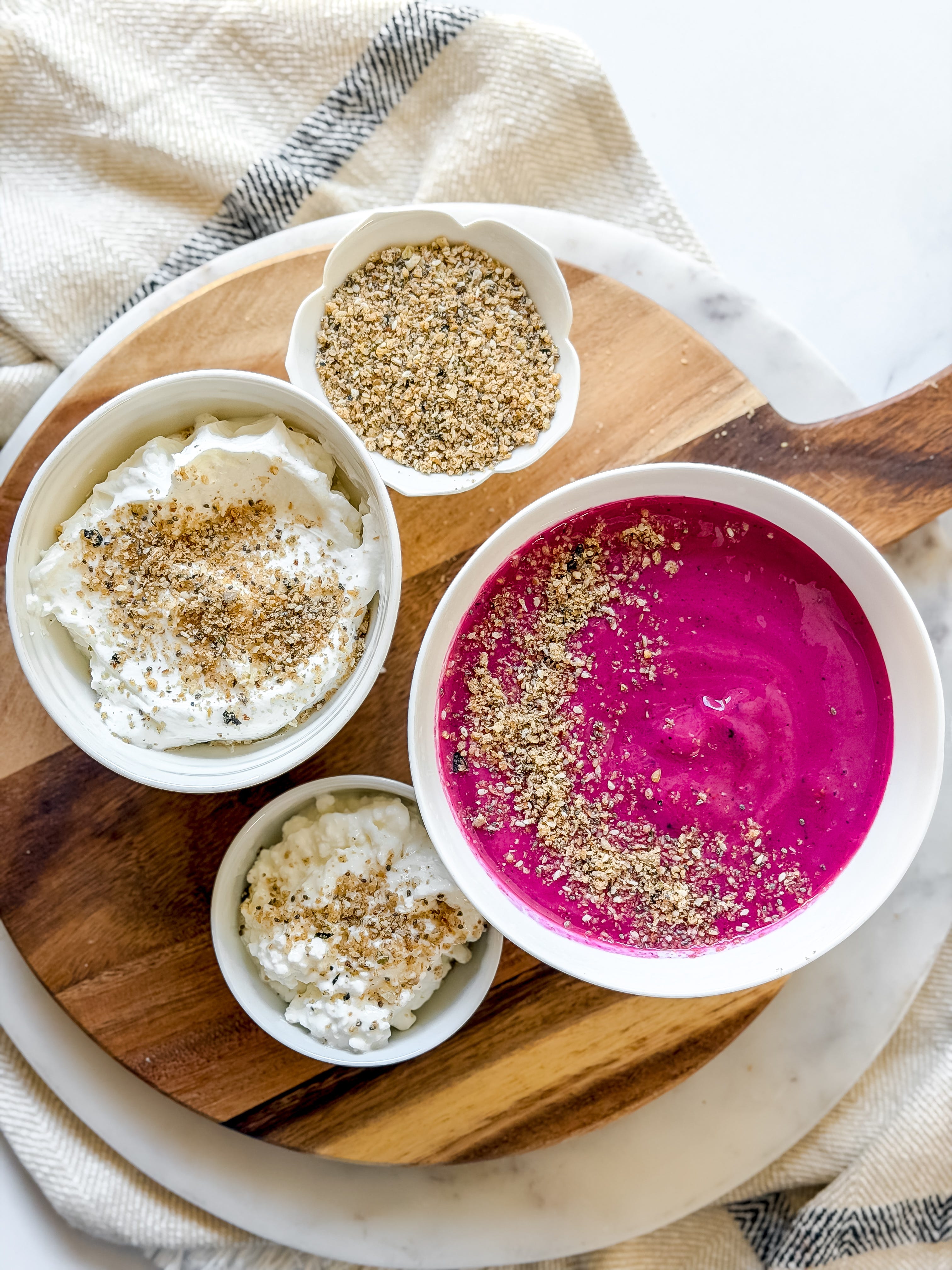
Not one of the five, but worth keeping on the counter: my Super Seed Sprinkle. Four grams of fiber and four grams of protein in a spoonful, stirred into yogurt, scattered over a salad, or dusted on steamed broccoli. Four grams doesn’t sound like much until you realize it’s the difference between a 6-gram lunch and a 10-gram one. This is what I reach for when a meal is coming up just short, but the easiest (and tastiest) boost I know of. Find my brand new super seed sprinkle recipe below, a new sweet and spicy version for Fall.
Batch-prep note: the Chili Pie freezes beautifully in individual portions, the Savory Protein Scones freeze and reheat in minutes, and the Super Seed Sprinkle keeps in a jar on the counter for weeks. Make once, eat all week.
putting it together: 3 sample days
Here’s how those recipes and a few simple assembled meals stack up. My rule is that fiber and protein travel together, so every meal below lands at 25g+ protein AND 10g+ fiber — never one at the expense of the other.
Day 1: Omnivore
Breakfast: High-Fiber Pancakes with 1/4 cup raspberries, and a side of turkey sausage → 33g protein / 30g fiber
Lunch: Chicken Chickpea Salad with Harissa Dressing → 30g protein / 12g fiber
Dinner: Chili Pie → 35g protein / 12g fiber
Day 2: Dairy-light
Breakfast: 3-egg scramble with 1 cup sautéed spinach, ½ avocado, and 2 oz smoked salmon → 28g protein / 10g fiber
Lunch: Big salad with 4 oz grilled chicken (or a can of wild salmon), ½ cup chickpeas, roasted broccoli, and Super Seed Sprinkle → 30g protein / 13g fiber
Dinner: Salmon with 1 cup Brussels sprouts and ½ cup lentils → 32g protein / 12g fiber
Day 3: Plant-forward
Breakfast: Smoothie with 1 scoop lupin chocho protein, 1/4 cup blackberries, spinach or kale, nut butter, and 1 tbsp ground flax → 30g protein / 15g fiber
Lunch: Lentil and roasted-veg bowl with ½ cup lupini beans and 3 tbsp hemp hearts → 28g protein / 16g fiber
Dinner: Chili Pie (double the beans, use the dairy swaps) → 30g protein / 13g fiber
A quick note: the recipe links carry verified macros from my own CGM testing. The assembled-meal estimates are close approximations — your own portions and specific ingredients may shift things slightly, but these will get you well past 30 grams every time.
a note before you dive in
If you're currently closer to 15 grams of fiber a day, don't jump to 40 grams overnight- that would be a recipe for bloating and discomfort. Add a few grams at a time over a week or two, and drink plenty of water as you go. Fiber pulls water in to do its job, so hydration is what keeps the whole thing feeling good instead of uncomfortable. Slow and steady wins here.
favorites from this post
Easiest win: Super Seed Sprinkle — 4g fiber, 4g protein, on everything
Most comforting: Chili Pie — 12g fiber per serving
Most versatile: Savory Protein Scones — 11 flavor variations

here’s what is waiting for paid subscribers below
This week’s paid post includes a full toolkit to get you to 30+ grams of fiber a day without the guesswork:
Sweet + Spicy Super Seed Sprinkle: a brand-new recipe, warmly spiced and just sweet enough. Stir it into yogurt, cottage cheese, or a smoothie bowl for an easy fiber and protein boost, or turn it into a warm cereal with a splash of warm milk, water, or kefir.
Fiber-by-Food Cheat Sheet: my go-to reference for exactly how many grams are in the whole foods I reach for most, so you can build any meal to target without guessing
The full week of fiber-forward menus: breakfast, lunch, dinner, and snacks, mapped to 30+ grams a day
My “ramp it up gently” guide: the exact 2-week on-ramp I give clients so more fiber never means more discomfort
The grocery list: everything you need to stock your pantry for every meal above
